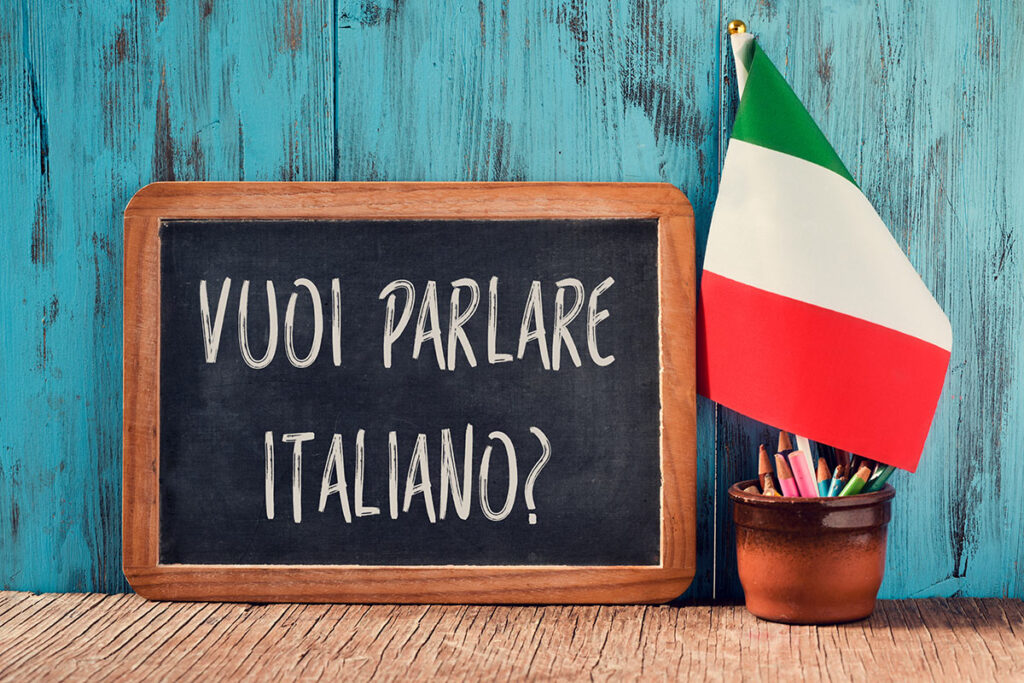
Want to speak like a true Italian? Discover how to learn Italian authentically with us, moving far beyond textbooks and grammar rules.
Studying Italian deeply means going beyond grammar rules, it means immersing yourself in everyday culture, history, gestures, and the social context.
From words that evolve over time to regional idioms and the hand gestures that accompany conversation, every element tells a piece of the Italian identity story.
Learning Italian therefore means connecting with a rich, dynamic reality that you can only truly understand by living it. We offer an engaging approach that transforms learning into an experience, bringing the language to life every single day.
Let’s explore how culture and tradition interweave in modern Italian, shaping the way people communicate every day.
How does an Italian person speak?
Italian is not a rigid, monolithic language, but a vibrant system with far more complex and diverse variations than you might imagine. The Italian spoken today springs from a living balance between different registers, both formal and informal, alongside local dialects and regional variations.
The average Italian tends to blend standard Italian, learned at school from childhood, with regional nuances. That is why, if you want to speak like a native, it is essential to experience Italian not merely as a subject to study, but as a tool for immersion and connection.
Viewed this way, language cannot be treated as a standalone entity, but rather as an essential element shaped by rich socio-cultural factors that cannot be ignored.
To offer international students the opportunity to learn Italian authentically, Centro Studi Italiani created the ICELD division, dedicated specifically to this mission.
Through hands-on, engaging experiences, we guide you on an immersive journey into Italy’s culture and lifestyle, enabling you to live the language daily and feel closer to being a true Italian.
The evolution of words within the social context
The evolution of words in the Italian language is inextricably linked to the social context and the everyday life of its speakers. Understanding how vocabulary has changed over time means delving directly into the culture and values that define Italian identity.
This evolutionary process began with the transition from Classical Latin to so-called “vulgar” Latin, the living spoken language of everyday people. It was spoken by rich and poor, scholars and intellectuals, as well as the uneducated.
It was precisely this grassroots foundation that allowed the language to transform gradually, reflecting societal shifts through various regional dialects.
Later, the masterpieces of great literary figures enriched the vocabulary with nuanced expressions, making culture more “democratised” and continuing to influence communication to this day.
Today, every word used carries a rich historical legacy that transforms Italian into an experience of culture and tradition woven into everyday regional life.
The role of gestures in Italian communication
Gestures are an essential part of the Italian language. Research into non-verbal communication shows that gestures in Italy serve very specific purposes: from expressing complex ideas and capturing attention to conveying emotions and, in some cases, replacing words altogether.
Not all gestures are universally understood: many carry regional meanings, creating a true regional sociolinguistic code that distinguishes a Neapolitan from a Venetian even in non-verbal communication.
This is one of the main reasons why learning Italian cannot be reduced to simple grammar exercises and textbooks.
Body language and hand gestures represent one of many dimensions through which the Italian language thrives, deeply rooted in its local and cultural context.
To truly grasp this in an authentic way, you need to experience everyday situations firsthand, connecting with the language as it is naturally spoken in real life.
Italian as a cultural identity
Italian is far more than just a linguistic code; it is the reflection of a deep identity woven from culture and heritage. Exploring the history of this language means diving into the mindset and values of its people, discovering the nuances that make Italian culture unique.
For this reason, Centro Studi Italiani’s mission is “learn Italy, not just Italian”, promoting full immersion across our country, where authentic “Italianness” is experienced beyond the textbook.
The literary roots of the Italian language, established by masters like Dante and Petrarch, helped shape an internationally recognised cultural heritage. Today, this legacy lives on through the language and lifestyle, expressing itself in various forms of daily life.
With our immersive courses, you can experience this reality directly, discovering not only the language, but also the cultural context that forms its true soul.